Microwave Digestion Systems for Trace Metal Sample Preparation

Whether you perform routine elemental analysis or process hundreds of samples every day, the quality of trace metal analysis starts long before the ICP-OES, ICP-MS, or AAS analyses. It starts with microwave digestion. 

Which microwave digestion system is best for your laboratory?

A modern microwave digestion system prepares samples quickly, safely, and reproducibly by using controlled microwave energy inside sealed digestion vessels. Compared with conventional acid digestion on hot plates, closed-vessel microwave digestion reaches higher temperatures and pressures, reducing digestion time while improving recovery and minimizing contamination.

For more than 35 years, Milestone has helped laboratories worldwide simplify sample preparation for ICP-MS, ICP-OES, and elemental analysis with microwave digestion systems designed for every workflow. Whether you need an entry-level system for routine analysis or a fully automated high-throughput platform, Milestone can guide lab managers and lab technicians to find the right microwave digestion system designed around specific laboratory workflows.

Rotor-based Microwave Digestion Systems

Rotor-based microwave digestion uses individual closed vessels arranged in a rotating rotor inside the microwave cavity. Each sample is sealed with the acid mixture and digested under controlled temperature and pressure. The closed-vessel design enables operation above the boiling point of the acids, while vessel materials and sealing components are selected to withstand digestion conditions.
Rotor-based systems are ideal for laboratories looking for reliable, traditional closed-vessel microwave digestion with excellent control, safety, and versatility.

High-throughput microwave digestion system

ETHOS is the most advanced microwave digestion systems for sample preparation.
It combines robust rotor technology, advanced process control, and an integrated digital system to help laboratories deliver reliable, reproducible digestion.

ETHOS LEAN
Compact microwave digestion system

ETHOS LEAN is a compact rotor-based microwave digestion system.
Designed for laboratories with low to moderate throughput requirements, it delivers reliable closed-vessel acid digestion without compromising safety, digestion performance, or application possibilities.

SRC Microwave Digestion Systems

Single Reaction Chamber microwave digestion uses one large pressurized reaction chamber where all samples are placed and digested simultaneously. Instead of individual pressure vessels, samples are introduced in simple vials inside the chamber. The chamber itself acts as the pressurized digestion chamber, allowing microwave energy to be distributed uniformly across the complete sample load under controlled temperature and pressure conditions.

ultraWAVE 2
The Single Reaction Chamber microwave digestion system

ultraWAVE 2 eco is the Single Reaction Chamber microwave digestion system designed to make microwave sample digestion more efficient. By reducing many  limitations of conventional systems, ultraWAVE 2 eco helps laboratories increase productivity while lowering operating costs.

ultraWAVE 3
The advanced Single Reaction Chamber microwave digestion system

ultraWAVE 3 is the most advanced Single Reaction Chamber microwave digestion technology, designed for laboratories that need higher productivity, greater digestion capability, and reliable control across demanding elemental analysis workflows.

ultraCLAVE
Fully automated Single Reaction Chamber microwave digestion system

ultraCLAVE allows laboratories to process large batches of samples with less manual handling, maximum safety, and greater ROI. It is designed for laboratories that need high productivity, simplified handling, and reliable digestion performance.

Comparison table

ETHOS LEANETHOSultraWAVE 2 ecoultraWAVE 3ultraCLAVE
Digestion technology
Rotor-based
Rotor-based
SRC technology
SRC technology
SRC technology
Reaction vessel option
PTFE vessels
PTFE vessels
PTFE, quartz and disposable glass vials
Application versatility
Multi-application capability
Focused on digestion
Mixed-batch capability samples
Moderate
Moderate
High
High
High
Process control
Individual vessel monitoring
Simultaneous chamber control
Handling time
Moderate
Moderate
Low
Low
Low
Reaction safety features
Vessels with built-in pressure release mechanism
Stainless-steel pressure reactor
Typical usage
Essential rountine & multi applications
Advanced routine and multi applications
Advanced routine and simplified workflow
Advanced and demanding workload and enahnced workflow
High-capacity and scale-up laboratories
Throughput level
Standard
Medium-high
Medium-high
High
Very high
Workload flexibility
Good
Very high
Very high
Very high
Very high
Smart assistance

Milestone Connect
Instant access to instrument information

Milestone Connect + AI
Instant access enhanced by AI

Milestone Connect
Instant access to instrument information

Milestone Connect + AI
Instant access enhanced by AI

Milestone Connect
Instant access to instrument information

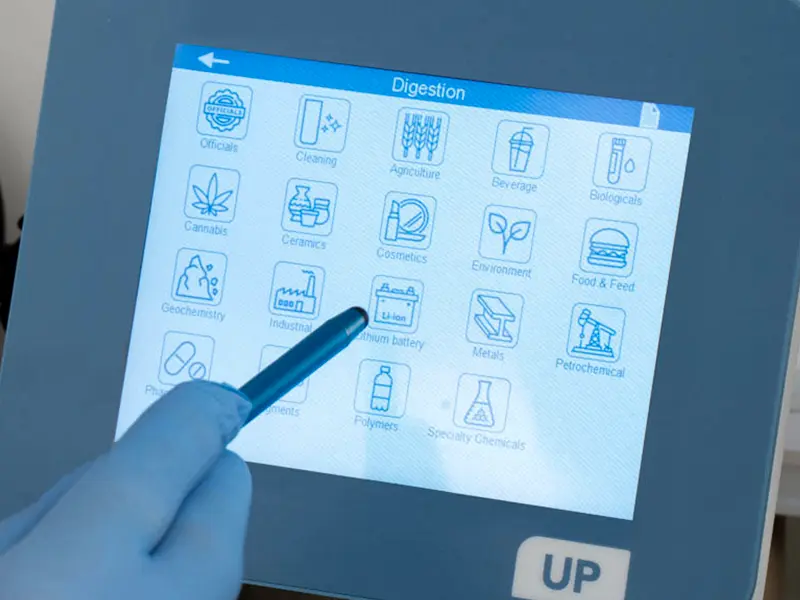
One technology, multiple applications

Microwave digestion is suitable for an exceptionally wide range of matrices, including:
Environmental
Environmental
Food and Feed
Food and Feed
Pharmaceuticals
Pharmaceuticals
Cannabis and Terpenes
Geological
Geological
Metals and Alloys
Metals and Alloys
Petrochemical and Energy
Polymers and Specialty Chemicals
Consumer Products
Consumer Products
Lithium-Ion Batteries

Beyond the instrument: complete microwave sample prep workflow

Choosing a microwave digestion system is a long-term investment. Milestone designs the complete workflow, including dedicated digestion rotors, advanced temperature sensor, intuitive software, and application support through Milestone Connect

Frequently Asked Questions

What is microwave digestion?
Microwave digestion is a sample preparation technique used to completely dissolve solid or semi-solid samples before elemental analysis. Using microwave energy inside sealed vessels, acids rapidly digest the sample under controlled temperature and pressure conditions, producing clear solutions suitable for ICP-MS, ICP-OES, AAS, and other analytical techniques.
How does a microwave digestion system work?
Microwave digestion uses microwave energy to heat acids inside sealed digestion vessels. Because the vessels remain closed throughout the digestion process, pressure builds naturally, allowing temperatures well above the boiling point of the acid.
These higher operating conditions dramatically accelerate sample decomposition while preventing the loss of volatile elements and minimizing external contamination.
The result is a clear, homogeneous digest ready for elemental analysis with techniques such as ICP-MS, ICP-OES, AAS, or ICP-AES.
Compared with traditional open-vessel digestion, microwave digestion has become the laboratory standard because of:

  • Faster digestion cycles
  • Higher digestion temperatures
  • Better recovery of volatile elements
  • Lower risk of contamination
  • Improved operator safety
  • Greater reproducibility between samples
Why is microwave digestion better than hot plate digestion?
Closed-vessel microwave digestion reaches higher temperatures and pressures, reducing digestion time while improving safety, reproducibility, and recovery of volatile elements.
What is microwave digestion used for?
Microwave digestion is used to prepare samples for trace metal analysis by ICP-MS, ICP-OES, AAS, and other elemental analysis techniques.
Which acids are used in microwave digestion?
Typically nitric acid, hydrochloric acid, hydrofluoric acid, sulfuric acid, and hydrogen peroxide, depending on the sample matrix and analytical method.
Which industries use microwave digestion?
Environmental, food, pharmaceutical, petrochemical, mining, battery, chemical, academic, cannabis, metallurgy, and life sciences laboratories.